
Preboarding
Preboarding is the period between a signed employment contract and the first working day, and everything the employer does in it before onboarding.
What is preboarding?
Preboarding is the period between a signed employment contract and the first working day, and everything the employer does inside it. Preboarding covers paperwork, equipment, introductions and the answers to practical questions. Preboarding ends the moment the new employee starts work, which is where onboarding begins.
What happens during preboarding?
Four things, and they rarely have one owner. Paperwork is collected, which is the part most employers manage. Equipment and access are ordered, which is the part that determines whether day one works. Someone stays in contact, which is the part that decides whether the person turns up at all. And the practical questions get answered, which is the part nobody plans: where to park, what to wear, which entrance, who to ask for, whether lunch exists.
The gap is longer than most plans assume. The statutory notice period in Germany is four weeks, and contracts or collective agreements can set longer ones (§622 BGB), so a signed contract can sit for weeks or months with nothing happening in it. That silence is the whole risk of the phase. It is also a gap in which the new starter has no work account, which is why anything sent to a company email address in this window reaches nobody.
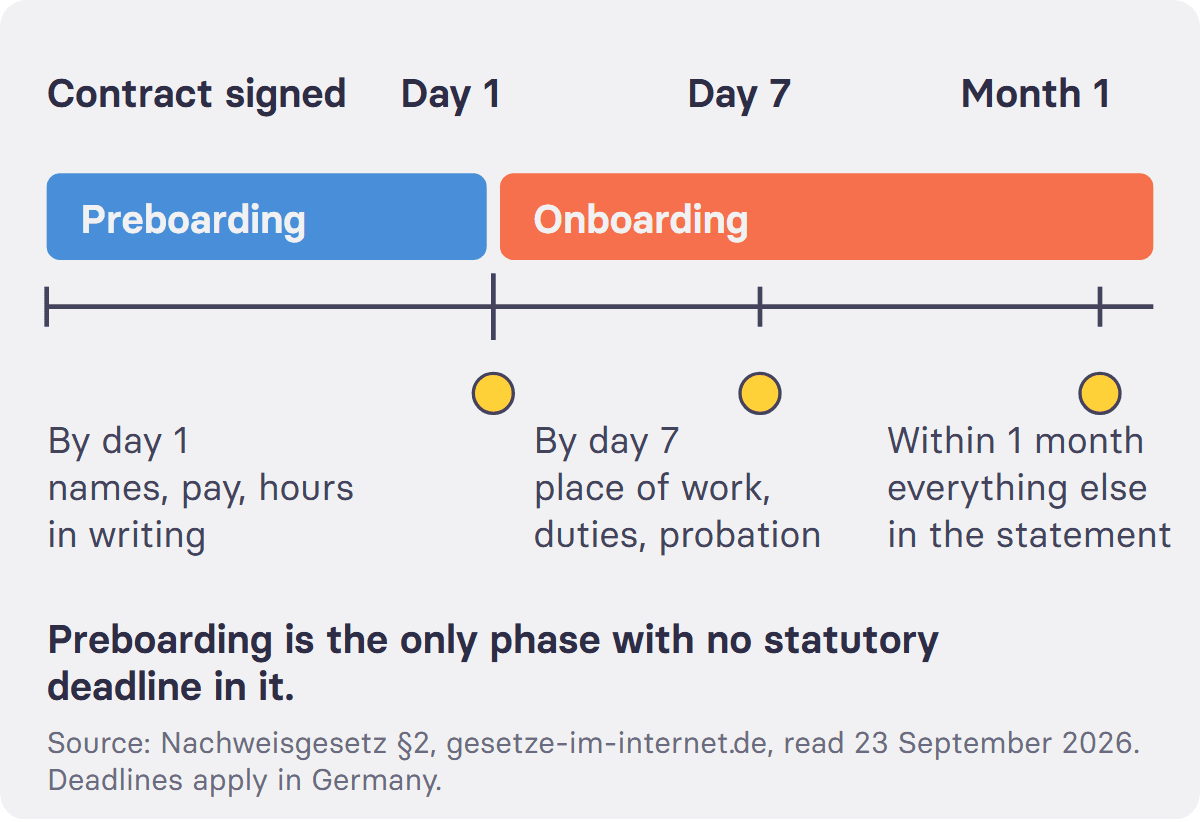
What is the difference between preboarding and onboarding?
The boundary is the first working day, and it is not an arbitrary line. Before it the person is contractually an employee and practically an outsider. No access, no colleagues, no routine, and no obligation to do anything. After it the employment relationship is running, and so are the employer's legal duties. In Germany, §2 of the Nachweisgesetz sets three separate deadlines across that boundary. Part of the written statement of employment terms must be handed over no later than the first day of work. A further part is due by the seventh calendar day after the agreed start. The rest follows within 1 month. An agreed probation period starts too: during it, §622 Abs. 3 BGB allows two weeks' notice, "längstens für die Dauer von sechs Monaten" (for at most six months). Preboarding is therefore the only phase after signature with almost no statutory content. Onboarding is the phase where the clock starts on several obligations at once. That is why the two are planned differently, and why treating preboarding as early onboarding produces a plan that does nothing for 8 weeks and then everything on one morning.
Does preboarding change anything?
The evidence for preboarding specifically is thin, and the evidence for onboarding as a whole is not. Gallup reported in 2018 that "only 12% of employees strongly agree that their organization does a great job onboarding new employees" (Gallup, on the onboarding experience). That is a statement about onboarding, not about the weeks before it, and anyone citing it as proof that preboarding raises retention is stretching it.
What can be said without stretching: the phase is cheap, most of it beyond the paperwork goes unmanaged, and the failure mode is specific. A person who hears nothing for two months and then receives a login on the morning of day one has been given a signal, and it is not a good one.
There is a second, structural reason the phase goes wrong, and it is about the channel rather than the intention. A new starter has no work account yet, so every tool the employer normally uses is closed to them. Many people in the existing workforce have no internet access for work either: across the EU 64.6% of people employed in enterprises with 10 or more staff have internet access for business purposes, and in German food, beverage and tobacco manufacturing the share is 39.2% (Eurostat, isoc_ci_cm_pn2, 2025). Shift patterns make it worse, since 9.3% of 42.6 million employed people in Germany worked at night at least occasionally in 2024 (Destatis, Mikrozensus 2024). Whatever you send during preboarding has to reach a private phone or a private email address, because there is no work account to reach yet.
How does tchop support the weeks before day one?
With tchop, an employer can give a new starter access to the employee app before their first working day, so the company news, the people and the practical answers are already there when they arrive. Access works without a company email address, which new starters do not have yet: they sign in with credentials from their employer or a sign-in link sent to a private address. An organisation that otherwise signs everyone in through single sign-on can run one of these methods alongside it for new starters. tchop is not an HR system, so contracts, the statutory written statement and payroll data stay where they are, and tchop does not touch them.
See how tchop supports HR teams.
FAQs: preboarding
What's the difference between preboarding and onboarding?
Preboarding is the period between the signed contract and the first working day. Onboarding is what happens from day one onward. The contract exists in both phases. The obligations, the access and the colleagues only exist in the second one.
What does preboarding mean for a job?
For the new starter it means the weeks between accepting and starting, when there is a signed contract and nothing to do. For the employer it means the one window in the process where contact is optional, which is why it is easy to leave empty.
What is the difference between boarding and onboarding?
Boarding, in a workplace context, is not a term of art. Onboarding is. If a document refers to boarding it usually means either the hiring process as a whole or the paperwork step inside it, and it is worth asking which, because the two have different owners.
Is preboarding legally required?
No. No statute requires contact between signature and start date. What the law does require sits on the other side of the line: in Germany, part of the written statement of terms by the first day of work, more of it by the seventh calendar day, and the remainder within one month under §2 NachwG. Preboarding is a choice, which is why it so often stops at the paperwork.
Scope note. The statutory deadlines on this page are German law. An employer outside Germany should read them as an illustration of where the legal boundary sits, not as its own obligations.